
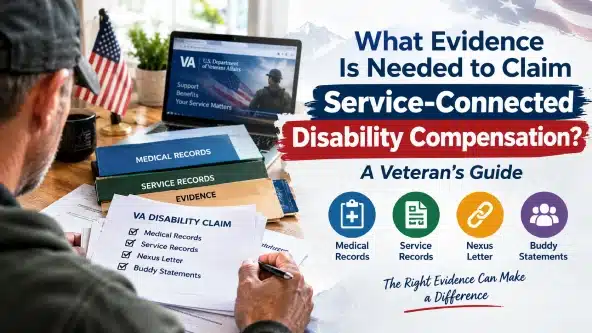
What Type of Evidence Is Necessary for a Disability Compensation Claim?
In a direct service-connected compensation claim, the typical proof required by the VA includes:
- Current mental or physical health disability.
- An incident or circumstance such as an injury, illness, or exposure to environmental risk affecting service in the past.
- The current condition is related to an event that occurred during military service.
By analogy, think of the claim like a narrative: the patient’s medical history tells us what is afflicting them currently, while their service record describes the circumstances surrounding the incident that occurred during their military service. Lastly, a doctor’s opinion or other proof may connect the two.
As an example, a veteran may be suffering from knee joint pain, have their service record stating an injury to the knee during active duty, and receive medical confirmation that their current knee condition is caused by the injury.
- Medical Proof of Existence of a Disability currently Applicable
The initial question is straightforward: Do you currently have a diagnosed medical affliction or sequence of maladies?
Among the useful pieces of proof, you may find the following:
- Medical information received from the Veterans Administration
- Health information of an individual given by his/her private physician
- Health history of treatment in hospitals
- X-rays, magnetic resonance imaging, computerized tomography, and tests conducted for diagnosis
- Outcomes of laboratory tests
- History of medicines prescribed
- Records of treatments taken
- Evaluations of mental state
- Information coming from specialists
While the procedure of diagnosis plays an important role, it is equally compulsory for you to provide other proofs describing the severity of your affliction. For instance, these proofs can describe the level of discomfort experienced, incapacity to move, sleeping disorders, intake of treatment, and effectiveness of the treatment received.
The higher quality of medical proofs, the quicker the VA will receive the information on the condition that is being treated.
- Evidence of Incidents, Injuries, or Illness during Military Service
The next question is: What occurred during your service?
This evidence may come from:
- Medical records obtained during military service
- Records of Army personnel
- Records of an overseas visit
- Reports of any incidents
- Reports of accidents
- Records of work carried out in the Army
- Records of training
- Reports of exposure to harmful agents
- DD214 and similar documents
Nevertheless, the absence of evidence does not mean the claim cannot be satisfied. The veteran may have suffered an injury, symptoms, or an adverse incident but did not turn to doctors immediately after that.
In these cases, other information will help to prove what happened and when.
The Role of Medical Nexus in VA Disability Claims
One of the key elements of a lot of VA claims is the medical nexus, which is basically the connection between the disability that you currently have and the military service.
The nexus from a medical provider may indicate why it is at least medically feasible for your current condition to be related to your military service.
For instance:
A veteran develops long-term back disorders years after his service ends. A medical provider reviews the individual’s records related to his military service, current diagnosis, and history of injuries that he had in the past and then issues the opinion confirming that the present disorder can be traced back to the injury sustained while in the service.
The nexus has to be proof of facts, and it should be based on logic and facts. A plain sentence, such as “this disorder is connected to service,” can hardly be effective.
When a Nexus May Not Be Required in the Same Way
Some conditions are considered presumptive conditions. If you meet the required service and medical criteria, VA may presume the condition is related to service. In those cases, you may not need to prove direct causation in the same way as a standard direct service connection claim.
Buddy Statements and Lay Evidence Can Back Up a Case
Many veterans fail to realize how important lay evidence can be.
A buddy statement, which is sometimes referred to as a lay statement, could originate from:
- A fellow service member
- A spouse
- A relative
- A friend
- A coworker
- A person who saw the original event
- A person who has seen your symptoms over time
A statement might say that you started feeling back pain because of a training accident or that your sleep issues and irritability first developed after you returned from overseas.
People giving lay testimony are not medical professionals. Their personal accounts are based on what they saw, heard, or experienced.
When making a lay statement, it should be specific to be useful. Instead of “he has had issues,” one should look for something like what happened, when symptoms appeared, and how it impacted the daily life of the person making the claim.
According to the VA, statements supporting a case can include the VA Form 21-10210 (also known as a lay or witness statement).
Evidence Needed for Different Types of VA Disability Claims
The evidence you need can change depending on the type of claim in your file.
Direct Service Connection Claim
You generally need evidence of:
- A current disability
- An in-service injury, disease, event, or exposure
- A link between the current disability and service
Secondary Service-Connected Disability Claim
A secondary claim involves a new condition caused or aggravated by an already service-connected disability.
For example, a Veteran may have a service-connected knee condition and later develop another condition that a medical professional connects to the service-connected disability.
Evidence may include:
- A current diagnosis
- Medical records
- A medical opinion explaining the connection
- Lay statements describing symptoms and changes
Increased-Rating Claim
If you already have a service-connected disability and believe it has become worse, current medical evidence is especially important.
This may include:
- Recent treatment records
- Updated diagnostic testing
- Specialist evaluations
- Medical opinions
- Statements describing worsening symptoms and functional limitations
Supplemental Claim After a Denial
If VA previously denied your claim, a supplemental claim generally requires new and relevant evidence. This could include a new medical opinion, newly obtained service records, additional treatment records, or other evidence that addresses the reason for the previous denial.
A Practical Evidence Checklist for Veterans
Before filing, organize your evidence into three categories:
Service evidence
- DD214 or separation documents
- Service treatment records
- Personnel records
- Deployment or exposure information
- Incident or accident reports
Medical evidence
- Current diagnosis
- VA and private treatment records
- Test results
- Medication history
- Specialist reports
- Medical nexus opinion, when appropriate
Supporting evidence
- Buddy statements
- Family statements
- Employment records
- Personal statements
- Documentation showing how the condition affects daily activities
You do not necessarily need to collect every document yourself. VA may help obtain certain federal records and other evidence, depending on the type of claim and the information you provide. However, submitting relevant evidence with your claim can help present a clearer picture of your case.
Common Mistakes That Can Hurt a VA Disability Claim
One common mistake is filing with only a current diagnosis. A diagnosis alone does not always prove that the condition is connected to military service.
Other problems include:
- Failing to explain what happened during service
- Ignoring relevant private medical records
- Submitting vague buddy statements
- Missing a scheduled C&P exam
- Not addressing the reason for a previous denial
- Waiting too long to gather important evidence
A well-prepared claim should tell a consistent story from service to the present day.
FAQs
What evidence is needed to claim service-connected disability compensation?
Most direct claims need evidence of a current disability, an in-service injury, illness, event, or exposure, and a connection between the current condition and military service.
Do I need a current diagnosis to file a VA disability claim?
A current diagnosis or medical evidence of a current disability is generally important. Medical records, testing, and treatment documentation can help establish the condition you are claiming.
What is a nexus letter for a VA disability claim?
A nexus letter is a medical opinion explaining the connection between a Veteran’s current disability and military service. It should be supported by medical reasoning and relevant evidence.
Can buddy statements help prove service connection?
Yes. Buddy statements and other lay evidence can describe events, symptoms, and changes that a person personally witnessed. They can support medical and service records.
Can I win a VA claim without service treatment records?
Possibly. The absence of service treatment records does not automatically end a claim. Other military records, lay statements, post-service medical evidence, and other credible evidence may help establish the claim.
What evidence is needed for a secondary service-connected disability?
You generally need evidence of a current condition and evidence connecting it to an already service-connected disability. Medical records and a medical opinion may be helpful.
What evidence is needed after a VA disability claim is denied?
For a supplemental claim, you generally need new and relevant evidence that was not previously considered, and that relates to the reason for the denial.
Build Your VA Claim Around the Evidence
When you know what evidence is necessary to prove a claim for service-connected disability compensation, the VA claims process becomes less daunting. Essentially, you will need to demonstrate three points, which will be your proof: Your current disability, the events during military service, and how the two are related.
Many types of documents- medical records, documentation related to military service, nexus opinions, and lay statements are essential evidence. Which documents you need to obtain depends on your claim and specific medical condition.
If you do not know what evidence to gather for your claim, it would be advisable to consult an experienced VA disability lawyer or accredited claims agent before you submit your claim. This expert would take a look at your case and give you advice on what evidence you may be lacking.
Ready to take action? Contact a qualified VA disability professional for help reviewing your evidence and preparing your claim. You can call, email, or complete an online consultation form to discuss your situation and learn what options may be available.