
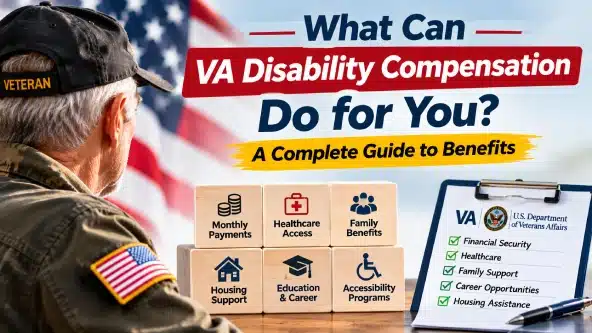
What Can VA Disability Compensation Do for You? A Complete Guide to Benefits
For many veterans, leaving military service does not mean leaving behind the injuries, illnesses, or health challenges that developed during their time in uniform. A service-connected condition can affect everyday activities, family responsibilities, employment, and long-term financial plans.
VA disability compensation is designed to help eligible veterans manage some of the financial impact of those conditions. But the monthly payment is only one part of the picture. Depending on your disability rating and personal circumstances, you may also qualify for additional support involving healthcare, dependent compensation, career development, accessible housing, and other veteran programs.
So, what can VA disability compensation do for you? It can provide tax-free monthly income and may help you access other benefits for which you meet the eligibility requirements. Understanding how these programs work can help you make informed decisions and avoid overlooking assistance that may be available.
What Is VA Disability Compensation?
VA disability compensation is a tax-free monthly benefit paid by the U.S. Department of Veterans Affairs to eligible veterans whose injuries or illnesses are connected to their military service.
A condition may qualify if it began during service or was made worse by service. Certain conditions may also qualify under presumptive rules, which recognize a connection between specific illnesses and qualifying military service or exposure.
The VA assigns a disability rating based on the severity of the service-connected condition and the applicable rating criteria. Ratings generally range from 0% to 100%.
A veteran with multiple service-connected conditions may receive a combined disability rating. The VA uses its combined-rating calculation rather than simply adding the individual percentages together.
Generally, monthly disability compensation begins at a 10% rating. A 0% rating recognizes a service-connected condition but does not provide monthly compensation for that condition at that rating.
What Can VA Disability Compensation Do for You?
VA disability compensation can help veterans in several practical ways. The most direct benefit is monthly financial support, but an established service-connected disability may also be relevant when applying for other VA programs.
It is important to understand one distinction: receiving disability compensation does not automatically qualify you for every VA benefit. Healthcare, housing grants, education programs, and other services each have their own eligibility requirements.
1. Provide Tax-Free Monthly Income
For many veterans, the most immediate benefit is a monthly payment that can help manage the financial challenges associated with a service-connected disability.
VA disability compensation is generally exempt from federal income tax. This means eligible veterans typically do not include these payments as taxable income on their federal income tax return.
Depending on their household budget, veterans may use this financial support toward:
- Mortgage payments or rent
- Utility bills and household expenses
- Groceries and everyday necessities
- Transportation costs
- Medical expenses not covered by other programs
- Family and childcare expenses
- Emergency savings and financial planning
The amount a veteran receives depends on the disability rating, applicable VA compensation rates, and whether additional allowances apply. Eligible dependents can affect the payment amount for veterans who meet the required rating threshold.
2. Help Veterans Access VA Healthcare
Managing a service-connected disability may involve regular medical appointments, medication, rehabilitation, or long-term treatment. VA healthcare can be an important resource for eligible veterans.
Depending on enrollment eligibility and individual circumstances, VA healthcare services may include:
- Primary and preventive care
- Specialty medical services
- Mental health treatment and counseling
- Prescription medications
- Physical and occupational therapy
- Prosthetics and assistive equipment
- Rehabilitation and other medically necessary services
Your disability rating can influence your VA healthcare priority group. For example, veterans with a service-connected disability rating of 50% or higher may qualify for Priority Group 1. Other veterans may qualify for different priority groups based on their service history, disability status, income, and other eligibility factors.
Receiving disability compensation and enrolling in VA healthcare are related but separate matters. A disability rating does not mean that every veteran receives identical healthcare benefits or services.
3. Provide Additional Compensation for Eligible Dependents
A service-connected disability can affect an entire household. For eligible veterans, the VA may provide additional monthly compensation for qualifying dependents.
Depending on the circumstances, eligible dependents may include:
- A spouse
- Dependent children
- Qualifying dependent parents
Generally, veterans with a combined disability rating of 30% or higher may qualify for additional compensation for eligible dependents.
The amount depends on the veteran’s disability rating, the number and type of eligible dependents, and other applicable factors. Veterans should also keep their dependent information up to date with the VA when family circumstances change.
It is worth remembering that additional dependent compensation is different from healthcare or education benefits for family members. Those programs have separate eligibility requirements.
4. Support Education, Training, and Career Development
A service-connected disability can change the type of work a veteran is able to perform. Someone who spent years in a physically demanding military occupation may find that returning to a similar civilian job is no longer practical.
The VA’s Veteran Readiness and Employment program, commonly known as VR&E or Chapter 31, may help eligible veterans prepare for, find, or maintain suitable employment.
Depending on an approved rehabilitation plan and individual eligibility, VR&E services may include:
- Career counseling and vocational planning
- Education and job-related training
- Employment assistance and job-search support
- Help exploring suitable career options
- Support for certain self-employment goals
- Services that help eligible veterans live more independently
Having a service-connected disability rating does not automatically mean that every applicant will receive every VR&E service. The VA reviews eligibility and evaluates whether the veteran has an employment handicap or other qualifying need.
5. Help Make a Home More Accessible
For veterans with certain severe service-connected disabilities, accessibility changes at home can make everyday life more manageable.
The VA offers housing grant programs that may help eligible veterans buy, build, or modify a home to accommodate qualifying disabilities.
Depending on the veteran’s circumstances and the grant requirements, home modifications may include:
- Installing wheelchair ramps
- Widening doorways
- Modifying bathrooms
- Improving access to essential living areas
- Making other qualifying accessibility changes
Two important programs are the Specially Adapted Housing (SAH) grant and the Special Home Adaptation (SHA) grant.
These grants are not available automatically to every veteran with a disability rating. Eligibility is based on specific qualifying disabilities and other program requirements. The VA also sets grant limits and funding rules.
6. Provide Access to Certain State and Local Veteran Benefits
Federal VA disability compensation is only one part of the benefits system. Many states and local governments also offer programs for eligible veterans with service-connected disabilities.
Depending on where you live, these programs may include:
- Property tax exemptions or reductions
- Vehicle registration or license plate benefits
- Reduced hunting and fishing license fees
- Tuition assistance or education benefits
- State park or recreation benefits
- Other state-specific financial or service benefits
Eligibility can vary significantly. Some programs consider the disability rating, while others may require a particular level of disability, permanent and total status, income qualifications, residency, or other conditions.
For that reason, do not assume that a benefit available in one state is also available in another. Contact your state department of veterans affairs or local veterans services office to confirm the current rules.
7. Reimburse Certain Travel Costs for VA Medical Care
Traveling to medical appointments can become a regular expense, particularly for veterans who need ongoing treatment or live far from a VA healthcare facility.
The VA Beneficiary Travel program may reimburse eligible veterans for certain transportation expenses associated with approved VA healthcare appointments.
Qualifying circumstances can include:
- Having a service-connected disability rating of 30% or higher
- Traveling for treatment of a service-connected condition
- Receiving a VA pension
- Meeting certain income requirements
- Traveling for a scheduled compensation or pension examination
Other eligibility and documentation requirements may apply. Reimbursement is not automatic simply because someone receives disability compensation.
8. Explore Additional Benefits for Eligible Family Members
Some VA programs extend beyond the veteran and may provide support to qualifying spouses, children, or survivors.
For example, eligible dependents and survivors may qualify for certain education or healthcare programs. These include:
- Chapter 35 Dependents’ Educational Assistance (DEA): May provide education and training benefits to eligible spouses and children of veterans who meet specific service-related disability or other qualifying conditions.
- CHAMPVA: A healthcare program for certain eligible spouses, dependents, and survivors who meet the program’s requirements and are not eligible for TRICARE.
- Survivor benefits: Programs such as Dependency and Indemnity Compensation (DIC) may provide benefits to eligible surviving family members under specific circumstances.
These programs are not automatically included with every VA disability award. For example, eligibility for Chapter 35 and CHAMPVA may depend on the veteran’s permanent and total status or other qualifying circumstances.
Can You Work While Receiving VA Disability Compensation?
In most cases, yes. Veterans can generally work while receiving regular VA disability compensation. A service-connected disability rating does not automatically prevent someone from having a job or earning an income.
However, there is an important distinction for veterans receiving Total Disability based on Individual Unemployability, commonly called TDIU or Individual Unemployability.
TDIU allows eligible veterans to receive compensation at the 100% rate when their service-connected disabilities prevent them from maintaining substantially gainful employment and they meet the applicable requirements.
Because TDIU is based on an inability to maintain substantially gainful employment, working can affect eligibility. Marginal employment and certain protected work environments may be treated differently under VA rules.
If you receive TDIU or are considering applying, understand the employment rules before making changes to your work situation.
Can You Receive VA Disability Compensation and Military Retirement Pay?
Some military retirees can receive VA disability compensation and military retirement pay at the same time. However, the rules depend on the veteran’s retirement status, disability rating, length of service, and applicable federal programs.
Two important programs are:
- Concurrent Retirement and Disability Pay (CRDP): May restore some or all of the military retired pay that is offset when an eligible retiree receives VA disability compensation.
- Combat-Related Special Compensation (CRSC): Provides eligible military retirees with tax-free payments for qualifying combat-related disabilities. Veterans must apply through their military service branch.
Not every veteran qualifies for either program, and the payment rules can be complicated. Review the applicable military retirement and VA compensation rules before making financial decisions.
How to Make the Most of Your VA Disability Benefits
Receiving a disability rating is an important step, but it is also worth reviewing whether your current benefits accurately reflect your circumstances.
These practical steps can help you stay organized and understand which programs may apply to you.
1. Review Your Current Disability Rating
Check your VA decision letter and current disability rating. Make sure you understand which conditions are service-connected and how the VA evaluated them.
If an established service-connected condition has become worse, you may be able to request an increased rating. The VA will evaluate the evidence and determine whether the applicable criteria for a higher rating are met.
2. Keep Medical Records and Supporting Documents Organized
Keep copies of relevant medical records, treatment notes, examination reports, and other documents related to your service-connected conditions.
Documenting changes in symptoms and functional limitations can also help you explain how a condition affects your daily life.
3. Understand Whether a Secondary Condition May Qualify
A secondary condition is a disability that is caused or aggravated by an already service-connected condition.
For example, a veteran may develop a separate medical condition that a qualified medical professional links to an existing service-connected disability.
These claims require evidence supporting the relevant medical relationship. Filing a secondary claim does not guarantee a higher combined rating or additional compensation.
4. Check Your Eligibility for Other VA Programs
Do not assume that your disability rating tells you everything about the benefits available to you. Some programs consider service history, medical needs, income, employment limitations, dependent status, or other eligibility factors.
Review the official VA information for healthcare, VR&E, housing grants, travel reimbursement, and family benefits to see which programs may fit your circumstances.
5. Keep Your Family and Contact Information Updated
Changes in marriage, divorce, dependent status, address, or other personal circumstances may affect certain VA benefits.
Keep the VA informed when required and check whether your existing records need to be updated.
Common Mistakes Veterans Should Avoid
Even after receiving a disability rating, veterans can overlook important details or misunderstand how different programs work.
Here are some mistakes worth avoiding:
- Assuming every benefit is automatic: Healthcare, housing grants, education programs, and travel reimbursement have separate eligibility rules.
- Ignoring changes in a service-connected condition: If a condition becomes worse, review whether an increased-rating claim may be appropriate.
- Overlooking dependent compensation: Eligible veterans with a combined rating of 30% or higher should check whether their dependent information is accurate.
- Confusing regular compensation with TDIU: TDIU has employment-related requirements that do not apply in the same way to ordinary disability compensation.
- Assuming a denied claim cannot be reviewed: The VA offers decision-review options, and the correct route depends on the reason for the decision and the evidence available.
- Relying on unofficial promises: Be cautious of anyone guaranteeing a particular disability rating or benefit outcome.
Learn more: Common VA Claim Mistakes to Avoid
What Should You Do If Your VA Disability Claim Is Denied?
A denied claim does not necessarily mean that you have no further options. The VA provides different decision-review paths, depending on the circumstances.
Three important options are:
- Supplemental Claim: Used when you have new and relevant evidence that was not considered in the previous decision.
- Higher-Level Review: Requests a review of the existing decision by a more senior reviewer. You generally cannot introduce new evidence through this option.
- Board Appeal: Allows you to appeal to the Board of Veterans’ Appeals, with different review options available.
Before choosing a review option, read the VA decision notice carefully. It explains the reasons for the decision and the applicable review rights and deadlines.
Learn How to Appeal a Denied VA Disability Claim
Frequently Asked Questions
1. What can VA disability compensation do for you besides monthly payments?
In addition to tax-free monthly compensation, eligible veterans may qualify for VA healthcare, additional payments for dependents, career and education support through VR&E, certain housing grants, travel reimbursement, and state-specific veteran benefits. Each program has its own eligibility requirements.
2. Is VA disability compensation taxable?
VA disability compensation is generally exempt from federal income tax. Veterans typically do not pay federal income tax on these payments. State tax treatment and other financial considerations should be checked separately.
3. Can I work while receiving VA disability compensation?
Generally, yes. Most veterans can work while receiving regular VA disability compensation. However, veterans receiving Total Disability based on Individual Unemployability (TDIU) must follow specific employment-related rules because that benefit is based on an inability to maintain substantially gainful employment.
4. Does VA disability compensation automatically qualify me for VA healthcare?
No. A service-connected disability rating can influence healthcare priority-group placement, but VA healthcare enrollment has its own eligibility requirements. Your military history, disability rating, income, and other circumstances may affect your eligibility and priority group.
5. Can I receive VA disability compensation and military retirement pay together?
Some eligible military retirees can receive both through programs such as Concurrent Retirement and Disability Pay (CRDP) or Combat-Related Special Compensation (CRSC). Eligibility depends on retirement status, service history, disability rating, and other program requirements.
6. What should I do if my VA disability rating does not reflect my condition?
Start by reviewing your VA decision and the evidence used to assign the rating. If a service-connected condition has worsened, you may be able to request an increased rating. If you disagree with a decision, you may have options such as a Supplemental Claim, Higher-Level Review, or Board Appeal. The appropriate option depends on your situation and the applicable deadlines.
Understanding What VA Disability Compensation Can Do for You
VA disability compensation can provide important financial support to veterans living with service-connected conditions. For many, the monthly tax-free payment helps manage everyday expenses and provides greater financial flexibility.
But it is worth looking beyond the monthly payment. Depending on your circumstances, you may also qualify for healthcare enrollment, dependent compensation, career assistance, housing grants, travel reimbursement, or other federal and state programs.
The most important thing is to understand that these benefits do not all follow the same eligibility rules. Your disability rating matters, but so can your medical needs, service history, employment situation, family circumstances, and other factors.
Take time to review your current VA benefits, keep your records updated, and use official VA resources to confirm what may be available. If you need help understanding your claim or the evidence involved, consider speaking with a VA-accredited representative.
Need help understanding the VA disability claims process? VetComm US provides educational resources and course-based guidance to help veterans better understand the information involved in preparing and navigating a VA disability claim. Explore the available resources to learn more about the process and the questions worth considering before taking your next step.