
How Does the VA Disability Rating System Work? A Complete Guide for Veterans
The world of VA disability benefits is often daunting and confusing for many veterans, filled with complicated rules and processes that are difficult to fully understand. Not knowing exactly how the VA disability rating percentage works and realizing just what a huge difference it makes in how much your monthly compensation will be is one of the most confusing and frustrating parts of this whole process.
Your disability rating is the primary and defining factor in determining how much financial assistance or money you may be entitled to through the Department of Veterans Affairs (VA). Even a slight modification or an increase in your disability rating percentage can radically affect the overall benefits that you receive and, importantly, impact your financial situation for years to come.
This guide will explain each step in the complicated VA rating process as clearly and simply as possible. It will break down how disability ratings are calculated or determined (again using plain language), clarify common mistakes and myths that commonly occur during claims procedures, and provide veterans with useful information on best practices to help them understand their claims and entitlements correctly.
Understanding the VA Disability Rating System
The VA disability rating system is used to evaluate the severity of a veteran’s service-connected medical condition.
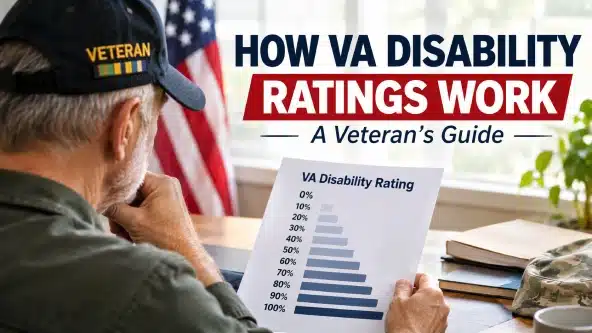
Ratings are assigned in increments of 10%, ranging from 0% to 100%.
The higher the rating, the greater the level of disability recognized by the VA and the larger the monthly compensation payment.
A disability rating serves two primary purposes:
- Measures the impact of a condition on your ability to work and function.
- Determines eligibility for compensation and additional VA benefits.
For example:
- 10% rating = mild impairment
- 50% rating = moderate impairment
- 100% rating = total disability
Every case is unique, and the VA reviews medical evidence carefully before assigning a percentage.
What Is a Service-Connected Disability?
However, the Department of Veterans Affairs (VA) must first determine that your medical condition is either directly related to or caused by your military service before you can be awarded a disability rating. This fundamental decision entails verifying that the disability is a direct result of or was substantially aggravated by conditions associated with your military service.
Here are various reasons why a service-connected disability may be present:
- An injury or damage sustained during service, whether during training exercises, combat operations, or other assigned duties.
- A disease that began or manifested during active service.
- Frequent exposure to toxic substances, such as chemicals, radiation, or environmental pollutants, during military duties.
- An existing condition made worse (aggravated or exacerbated) by your military service, meaning its severity increased beyond its pre-service level.
Among the most common types of service-connected disabilities, covering a wide spectrum, are those related to various physical and mental health factors:
- Post-Traumatic Stress Disorder (PTSD), frequently connected to combat situations or traumatic events encountered during service.
- Hearing loss (often a result of noise exposure, such as gunfire, explosions, or aircraft engines during service);
- Various back problems caused by physical activity, lifting heavy objects, or accidents during military service.
- Knee conditions resulting from repetitive stress injuries (due to training exercises or other physical exertion during service).
- Migraines related to stress, traumatic brain injuries, or other service-connected factors.
- Sleep apnea (a sleep disorder that may arise or worsen during military service as a result of health conditions and/or environmental exposures).
- Tinnitus: a persistent ringing or buzzing in the ears, often caused by exposure to noise during service.
After the VA definitively determines that your disability is a direct result of (not merely coincidental with) your military service, it will assess how disabling and significant this condition has been for you. It is essential that this assessment accurately reflects your condition, as it determines the amount of disability compensation and benefits you are eligible to receive.
How the VA Assigns Disability Ratings
The VA uses a detailed schedule known as the VA Schedule for Rating Disabilities (VASRD).
Each condition has specific criteria that determine the percentage assigned.
The VA reviews:
Medical Records
Medical documentation is one of the most important factors in your claim.
Records may include:
- Military treatment records
- VA medical records
- Private physician reports
- Diagnostic test results
Compensation and Pension (C&P) Exam
A C&P exam helps the VA assess your condition.
During the exam, a medical professional evaluates:
- Symptoms
- Functional limitations
- Severity of the condition
- Impact on daily life
Many veterans underestimate the importance of the C&P exam. Accurate and detailed responses can significantly influence the final rating.
Supporting Evidence
Additional evidence may strengthen your claim, including:
- Buddy statements
- Family statements
- Employment records
- Personal disability journals
How VA Disability Percentages Work
The VA assigns percentages based on how much a condition affects your ability to function.
Typical ratings include:
A 0% rating may not provide monthly compensation, but it still establishes service connection and can help support future claims if the condition worsens.
How the VA Combined Rating Calculator Works
One of the biggest surprises for veterans is that the VA does not simply add ratings together.
For example:
Many people assume:
- 50% disability + 30% disability = 80%
However, the VA uses a combined rating formula.
Here’s a simplified example:
- First disability = 50%
- Remaining efficiency = 50%
- Second disability = 30% of the remaining 50%
- Additional disability = 15%
Combined rating = 65%
The VA then rounds to the nearest 10%, resulting in a 70% rating.
This method is often called “VA Math.”
Because calculations can become complex with multiple conditions, many veterans use a VA combined rating calculator to estimate their overall rating.
VA Disability Compensation and Monthly Benefits
Your disability rating directly affects your monthly compensation.
Generally:
- Higher ratings receive higher payments.
- Veterans with dependents may receive additional compensation.
- Certain severe disabilities may qualify for special monthly compensation (SMC).
Benefits may include:
- Tax-free monthly payments
- Healthcare access
- Vocational rehabilitation
- Education assistance
- Housing-related programs
As ratings increase, additional programs and benefits may become available.
Common Mistakes Veterans Make
Understanding these common mistakes can help strengthen your claim.
Missing Medical Evidence
Insufficient documentation is one of the leading causes of low ratings and claim denials.
Always submit complete medical records whenever possible.
Downplaying Symptoms
Many veterans minimize their symptoms during medical evaluations.
Be honest and explain how your condition affects daily activities, work, and relationships.
Missing C&P Exams
Failure to attend a scheduled C&P exam can negatively impact your claim.
Always attend or promptly reschedule if necessary.
Not Appealing an Unfavorable Decision
If you believe your rating is too low, you may have options to appeal or request a review.
Many veterans successfully receive higher ratings after submitting additional evidence.
How to Increase Your VA Disability Rating
If your condition worsens over time, you may qualify for a higher rating.
Follow these steps:
Step 1: Gather Updated Medical Records
Document any worsening symptoms or new complications.
Step 2: Obtain Medical Opinions
A doctor’s statement may help support your request for an increased rating.
Step 3: File for an Increase
Submit a claim requesting a higher evaluation.
Step 4: Attend Any Required Exams
The VA may schedule another C&P examination.
Step 5: Provide Additional Evidence
Include treatment history, employment impacts, and personal statements.
Expert Insight: Why Accurate Documentation Matters
Those who have worked with veterans regularly observe situations where proof is inadequately filled out, leading to claims being postponed or even resulting in a lower disability rating. For example, a veteran who suffers from chronic migraines might only receive an initial rating of 0%, which is not commensurate with the degree of disability. However, once the veteran organizes his or her evidence and presents a volume of documentation—such as proof of absences from work due to migraines, statements from medical providers who have treated them for the condition, and detailed descriptions about how often their headaches occur, along with details regarding head pain severity—they can increase their disability rating. The basic lesson here is simple, yet very important: meticulous and detailed documentation of the claim process is essential. The stronger and more elaborate your evidence is in support of the claim, the better chance you will have of success.
Frequently Asked Questions
How does the VA disability rating system work?
The VA assigns disability percentages from 0% to 100% based on the severity of service-connected conditions. The rating determines compensation and benefit eligibility.
What is a good VA disability rating?
There is no “best” rating. The appropriate rating reflects your condition’s severity and its impact on daily life.
How does the VA combined rating calculator work?
The VA combines ratings using a formula that considers remaining efficiency rather than simply adding percentages together.
Can I receive VA compensation with a 0% rating?
Yes. A 0% rating establishes service connection, although it usually does not provide monthly compensation.
Can I increase my VA disability percentage later?
Yes. If your condition worsens, you may file a claim for an increased disability rating with supporting evidence.
What happens after the C&P exam?
The examiner submits findings to the VA, which reviews the evidence and issues a rating decision.
How long does the VA disability claim process take?
Processing times vary depending on claim complexity, evidence, and workload, but many claims take several months to complete.
Every veteran seeking compensation benefits needs to fully understand the complexity of VA disability ratings. The disability rating you are assigned impacts the amount of monthly cash payments you receive, and these ratings also largely determine your access to an array of critical services, including but not limited to healthcare eligibility, educational opportunities such as school tuition assistance programs, or job training workshops.
You can strengthen your chances and position yourself to maximize success with a claim by obtaining strong, objective medical evidence; diligently attending Compensation and Pension (C&P) examinations; and understanding the specific methodology for calculating VA disability ratings.
What Should You Do?
If you need help with filing a VA disability claim, getting a higher rating, starting an appeal, or performing a thorough benefits analysis, it is recommended that you contact a veterans’ benefits professional. You might even decide to complete an online inquiry form or a personalized consultation, which will provide you with more clarity on your options regarding your condition and the necessary next steps that should be taken, depending on your circumstances.